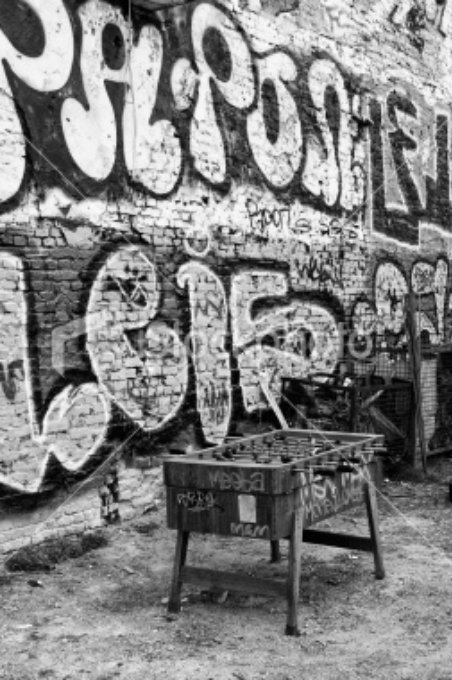
Babyfoot is a competition that requires intense training, ruthless determination and superb physical fitness. Well, make that a predilection for going down the pub, club-ability and a strong pair of wrists.
Table football - aka babyfoot or foosball - is big business, and its promoters hope that it will one day take its place beside snooker, darts and table tennis as a fully-fledged international sport.
"What we want to do is eventually have a world circuit, like in golf and tennis, with maybe four or five major tournaments every year around the world," says Ludovic Neri, director of the French Table Football Federation. "But before that we need to regularise the game."
The biggest challenge is the multiplicity of table types and rules that prevail in different countries.
In
The Italians play on garlando, which has a much faster surface and use a harder ball.
The game played is calcio balilla, or biliardino.
The Portuguese play on an elegant wooden table with hard plastic balls, a very fast game indeed, and you better pay attention to the bars.
The Germans and Dutch play on Deutscher Meister, which is also much faster and use hard balls. In German itself it's called Kicker or Tischfußball.
The Americans use tornado tables and the game is known there as Foosball (from the german Fußball soccer).
The Spanish for table football is futbolín. In
And the game's laws have been a law unto themselves.
"I used to joke that the French rules could be summed up in four words: Francais oui, Anglais non," says Boris Atha, a British player taking part in the individuals competition in
"The French used to have a lot of bizarre (vous avez dit bizarre ?) ideas - like you couldn't score from the midfield or if the ball bounced out of the goal it counted double."
He added: "And at local level there are still as many different sets of rules as there are cafes.
"But thanks to the international federation things are getting more consistent."
They say that table football was invented in
They also say that it was invented by Alejandro Finisterre during the spanish civil war.
In fact it almost certainly developed simultaneously in many places as carpenters turned out wooden toys to simulate the newly-official game of soccer.
What is certain is that in the years after World War I it became immensely popular in
"I began playing in about 1930 when babyfoot had just started," said Bernard Jeanbernard, an 84 year-old wielding the rods in the veterans' competition.
"I still play because it is in my blood, and I like beating the youngsters."
In the 1950s babyfoot developed its cult status in
This was when GIs returning to the
And this was also the time when generations of British youngsters began to discover the seductive thrill of the game on summer holidays at campsites and hotels in
Nowadays the sport is played by millions across the world, and in Europe and the
"It's a real game, against a real opponent, with a real ball, in real time," says Mr Atha.
"And the beauty is you can keep playing it until you drop."